Do You Really Need Kubernetes? What the Latest CNCF Research Means for Small Teams
Kubernetes can solve difficult deployment problems. It can also give a small team a platform to maintain before that team has a platform problem.
The useful question is not whether Kubernetes is popular. It is whether your application needs capabilities that justify its operating cost, and whether someone can own the resulting system.
For an early SaaS product with one application and predictable traffic, a VPS with a repeatable deployment process may be a strong starting point. For a team coordinating many independently deployed services, Kubernetes may offer a more consistent way to run them. Neither choice is a permanent commitment.
What the latest CNCF survey actually says
The CNCF Annual Cloud Native Survey announcement, published in January 2026, reports that 82% of surveyed container users ran Kubernetes in production in 2025. The corresponding figure was 66% in 2023.
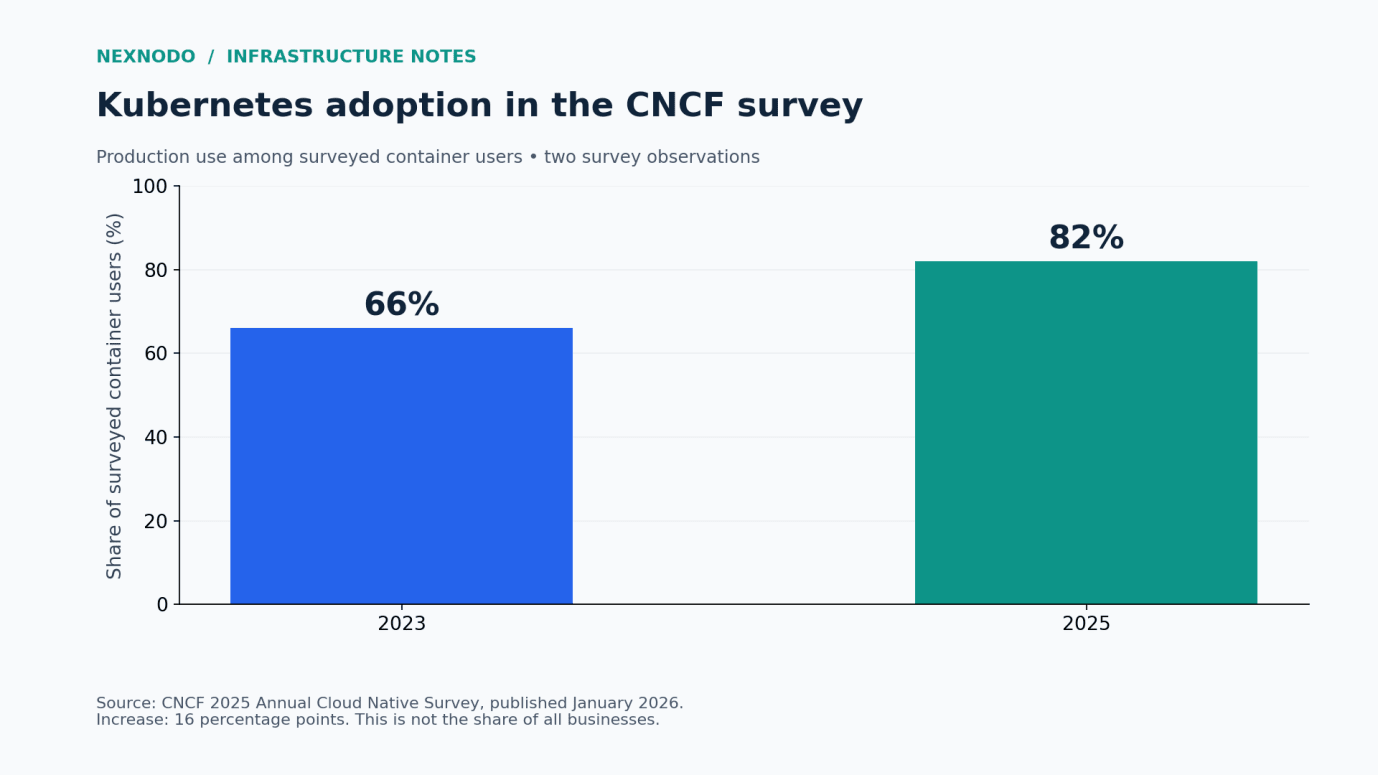
The finding establishes Kubernetes as a widely used production platform in this community. It does not measure the return a three-person startup will get from adopting it. Survey populations and respondent composition also matter when interpreting changes over time.
Our recommendation is to use the research as context, then make the architecture decision from your own deployment frequency, failure requirements and operating capacity.
When a VPS is a reasonable production choice
Consider a small booking application: one API, one frontend, a database and a worker. Two developers release changes a few times a week. The main operational needs are predictable deployment, secure access, monitoring and recoverable data.
A single host can be a reasonable fit if the business accepts its failure and maintenance limits. Docker's production guidance for Compose explicitly covers single-server deployment and production-specific configuration. Containers do not require Kubernetes to be useful.
A practical baseline is a versioned application image, production configuration separated from development, a controlled release process, external monitoring and off-server backups with tested restoration. Keep the database inaccessible from the public internet unless a specific, secured access design requires otherwise. Maintain secrets outside images and source code.
This design still needs an owner. Host patching, disk capacity and failed backups do not disappear because the application runs in containers. Its virtue is that a small team can often understand the complete system and recover it without operating a cluster.
The problems that make Kubernetes worth evaluating
Kubernetes becomes more compelling when operational coordination is a recurring constraint. Examples include multiple services releasing independently, workloads that need different resource allocations, and teams needing consistent deployment policies across environments.
| Your recurring problem | First question to ask | Kubernetes relevance |
|---|---|---|
| A single database is slow | Have queries, indexes and storage been measured? | A cluster is not the first fix for a database bottleneck. |
| One service needs more capacity | Can it be resized or replicated simply? | Orchestration helps when managing replicas becomes recurring work. |
| Many services have inconsistent releases | Can a shared pipeline solve enough of the problem? | Declarative deployment can give teams a common operating model. |
| A host failure stops the product | What recovery or availability target must be met? | Rescheduling helps only alongside resilient data and networking. |
| Several teams need a standard platform | Who owns policies, upgrades and support? | A platform team can amortize the cluster's operating effort. |
Avoid adopting Kubernetes solely because a roadmap says “microservices.” Start with a concrete failure or workflow that the platform will improve. Write an acceptance test: for example, demonstrate an application rollout and rollback, or recover service after deliberately losing a worker in a safe test environment.
Three workers do not automatically mean high availability
Application replicas need somewhere healthy to run, enough spare capacity, and a traffic path that reaches them. The database and storage must also survive the failure you are planning for. Spreading pods across three machines is not the same as spreading them across independent failure domains.
The Kubernetes production environment guide discusses availability, scale, access and operational responsibilities. Read the provider's management boundary alongside it: who owns the control plane, node upgrades, storage integration and restoration?
For sizing, distinguish advertised machine resources from capacity available to application workloads. System components use resources too. Kubernetes resource-management documentation explains how requests influence scheduling and how limits affect runtime resource use. Setting numbers without measuring the workload can create inefficient allocation or unstable behavior.
Compare operating effort before migrating
Use a simple value model rather than an arbitrary threshold such as “Kubernetes after 10,000 users.”
Suppose the new platform adds $120 per month in infrastructure and four monthly hours of platform work at $50/hour. Its incremental operating cost is $320 per month. If it saves eight hours of repetitive release work, the assumed time value is $400, leaving $80 of monthly benefit before migration costs.
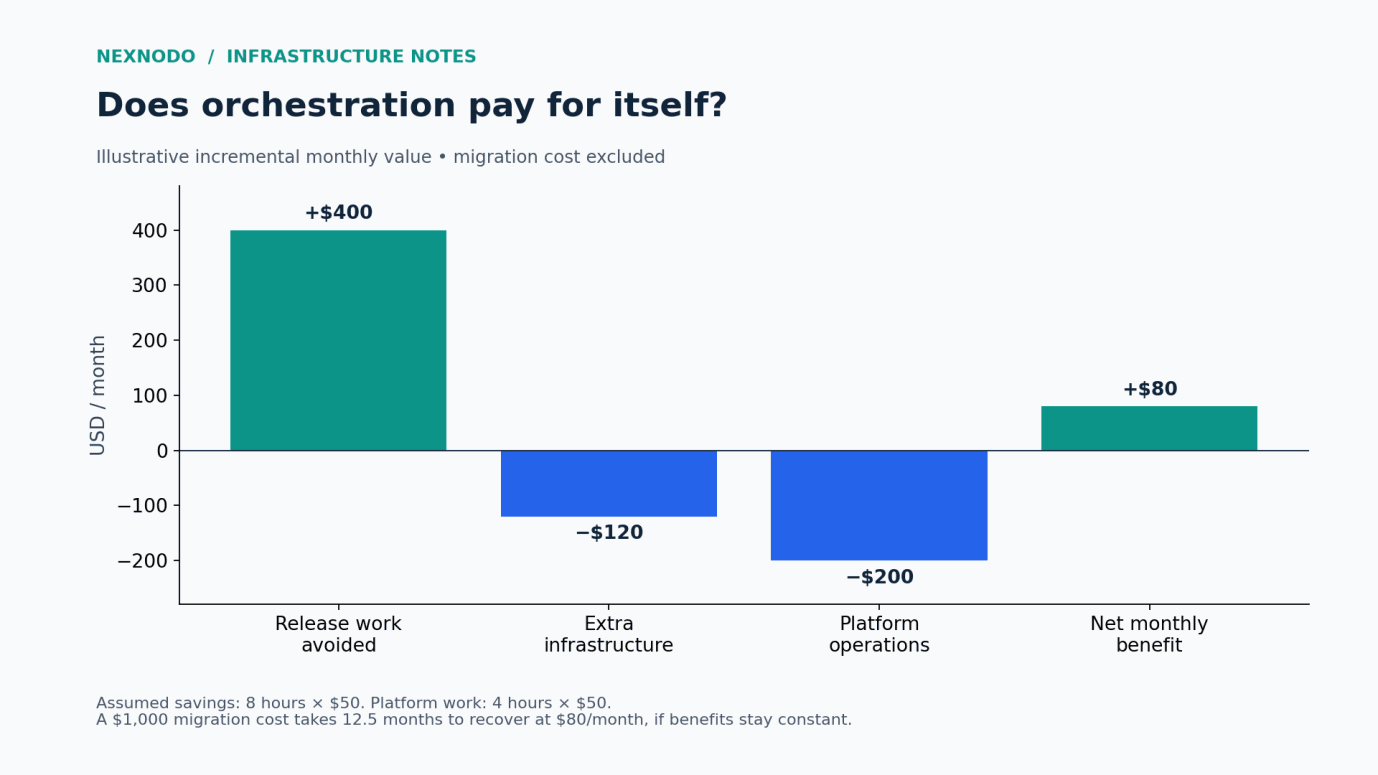
If migration takes 20 hours at the same rate, its $1,000 cost would take 12.5 months to recover at an $80 monthly benefit, assuming the benefit remains stable. If the team saves only four hours per month, the model is negative by $120. Reliability benefits may justify the migration anyway, but should be documented separately rather than assumed.
A migration path that preserves options
You can prepare for growth without deploying a cluster immediately:
- Package the application reproducibly and document its configuration.
- Identify persistent data and test its backup and restore process.
- Separate background work from interactive request handling where useful.
- Add health checks, useful metrics and a repeatable release pipeline.
- Trial the proposed platform with representative traffic and a rollback plan.
These steps improve a VPS deployment today and reduce uncertainty during a later migration. They do not require splitting a well-functioning application into dozens of services.
Decide by responsibility, not fashion
Stay with the simpler system when it meets your targets and the team can operate it well. Evaluate Kubernetes when orchestration solves a repeated problem, the expected benefit is measurable, and a named person or team owns the platform.
Managed Kubernetes can reduce the work you perform, but read the service boundary carefully. Your application, data protection and configuration still need explicit ownership.
Next step: Build a budget with The Real Cost of Running a Small SaaS in 2026, then explore NexNodo for infrastructure matching your requirements.
Sources and methodology
- CNCF — January 2026 survey announcement and survey report: adoption figures.
- Docker — Use Compose in production: single-server production guidance.
- Kubernetes — Production environment and Resource management: operational and resource-planning reference.
- Financial examples are original illustrative assumptions, not measured savings. Sources checked on 22 October 2026.