Best VPS Providers in Europe in 2026: How to Compare Your Options
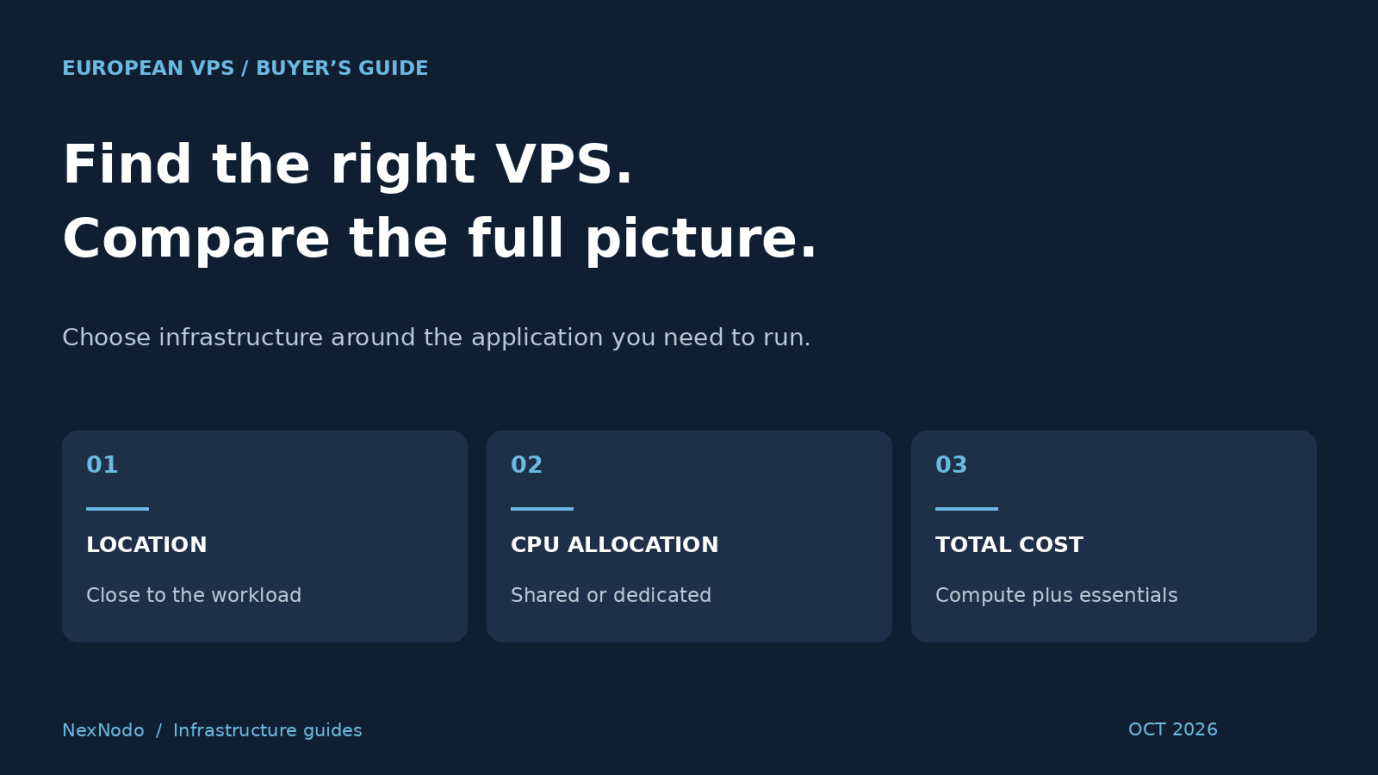
The best VPS provider in Europe is the one that meets your workload’s requirements at a predictable total cost. That means comparing more than the monthly price: CPU allocation, storage, network limits, location and billing rules can all change the result.
Hetzner, OVHcloud, Contabo, Scaleway, DigitalOcean and Vultr offer different approaches to virtual servers. NexNodo adds another route: comparing infrastructure from independent providers through a marketplace.
This guide helps you build a shortlist and compare equivalent configurations. It is an editorial comparison of published product information, not a hands-on performance ranking. NexNodo publishes this article and is included as a marketplace option; the other providers listed are not necessarily available through NexNodo.
European VPS providers at a glance
Here, “in Europe” refers to deployment locations, not necessarily the provider’s headquarters or ownership. Product availability still depends on the selected location.
| Option | Why consider it? | What to check before ordering |
|---|---|---|
| Hetzner | Shared and dedicated-vCPU cloud families | CPU class, IPv4 charges and location availability |
| OVHcloud | VPS packages with bundled network and backup features | Offer conditions, port speed and backup scope |
| Contabo | Memory and storage allocations worth comparing for budget workloads | Shared CPU, contract term and final configuration cost |
| Scaleway | Several instance families within a broader cloud platform | Separate storage and IP charges |
| DigitalOcean | Droplets alongside managed application infrastructure | Bundled versus v5 billing and transfer allowance |
| Vultr | Multiple compute categories and international deployment options | Exact plan availability, CPU class and network allowance |
| NexNodo | Search and deployment across independent providers | Each offer’s operator, location, specification and billing model |
1. Hetzner: compare shared and dedicated compute separately
Hetzner’s cloud portfolio includes shared-resource instances and dedicated-vCPU instances. Its server documentation identifies German and Finnish cloud locations and explains that shared plans distribute compute capacity between instances on the host.
That makes it useful to create two shortlists: one for bursty applications and another for sustained CPU demand. Comparing an entry shared plan with a dedicated plan as if the core counts were interchangeable will produce a misleading result.
For a dated price reference, Hetzner’s published adjustment table lists CX23 at €5.49 per month, excluding VAT and IPv4, for Germany and Finland. Treat this as a published reference, not a guarantee of stock or your final checkout price.
Consider it when: its available locations and compute families match a self-managed workload.
2. OVHcloud: examine what the VPS package includes
OVHcloud’s Ireland VPS page advertises an entry VPS-1 offer from €3.81 excluding VAT per month, with 2 vCores, 4 GB RAM and 40 GB NVMe storage. It also advertises daily backup, anti-DDoS protection and unlimited traffic, subject to the selected offer and location conditions.
These bundles deserve attention when the cost of network transfer or backup would otherwise sit outside your VM budget. However, unlimited transfer is not unlimited speed: the selected port rate remains a constraint. A bundled backup also needs to match your recovery requirements.
Consider it when: the included services match your application and make the whole package competitive.
3. Contabo: evaluate RAM and storage against CPU needs
Contabo documents its Cloud VPS as KVM-based infrastructure using shared vCPUs. Its published Cloud VPS 20 configuration includes 6 vCPUs, 12 GB RAM and 100 GB NVMe, with an SSD alternative.
This is a useful candidate for applications that need memory or disk capacity but do not continuously saturate the processor. The specification alone does not establish how it will perform against another provider. Run your application under representative load before choosing on core count.
Consider it when: memory and storage are your main sizing constraints, and the applicable contract fits your usage.
4. Scaleway: compare the full instance configuration
Scaleway offers multiple instance categories, including shared and dedicated CPU options. Its compute-optimized and memory-optimized categories describe dedicated vCPUs without overprovisioning.
Its CPU instances use hourly billing, while storage and flexible IPv4 addresses are billed separately. An attractive compute rate therefore needs to be combined with the disk and networking configuration you will actually deploy.
Consider it when: you want to choose between several compute profiles within a wider cloud environment.
5. DigitalOcean: match the plan to the billing model
DigitalOcean combines Droplets with services such as managed databases and Kubernetes. That can be useful when you want to reduce the number of infrastructure components your team operates itself.
Its current CPU Droplet documentation specifies per-second billing with a minimum charge of 60 seconds or $0.01, whichever is higher. Bundled plans have a monthly usage cap; v5 configurations do not.
Consider it when: the surrounding services fit your application, and their operational value justifies the total bill.
6. Vultr: shortlist the exact compute category and location
Vultr’s Cloud Compute documentation distinguishes Cloud Compute, High Frequency and High Performance categories. Its international footprint includes European locations, but the relevant question is whether the specific configuration you need is available in your chosen city.
Do not interpret a performance-oriented product name as proof of dedicated CPU allocation. Check the product specification, then test the workload.
Consider it when: location choice and compute-category flexibility are important to your deployment.
7. NexNodo: start with the infrastructure requirement
NexNodo is a marketplace for infrastructure operated by independent providers. Its search and pricing pages let you compare offers by location and resource configuration, with the applicable provider and pricing model shown before deployment.
A marketplace is useful when you want to explore regional providers without beginning with a particular brand. It does not make every offer technically identical: CPU allocation, network limits, support and billing still need to be checked for the resource you select.
Consider it when: you want to compare independent infrastructure offers through one platform.
Compare the total cost, not just the VM price
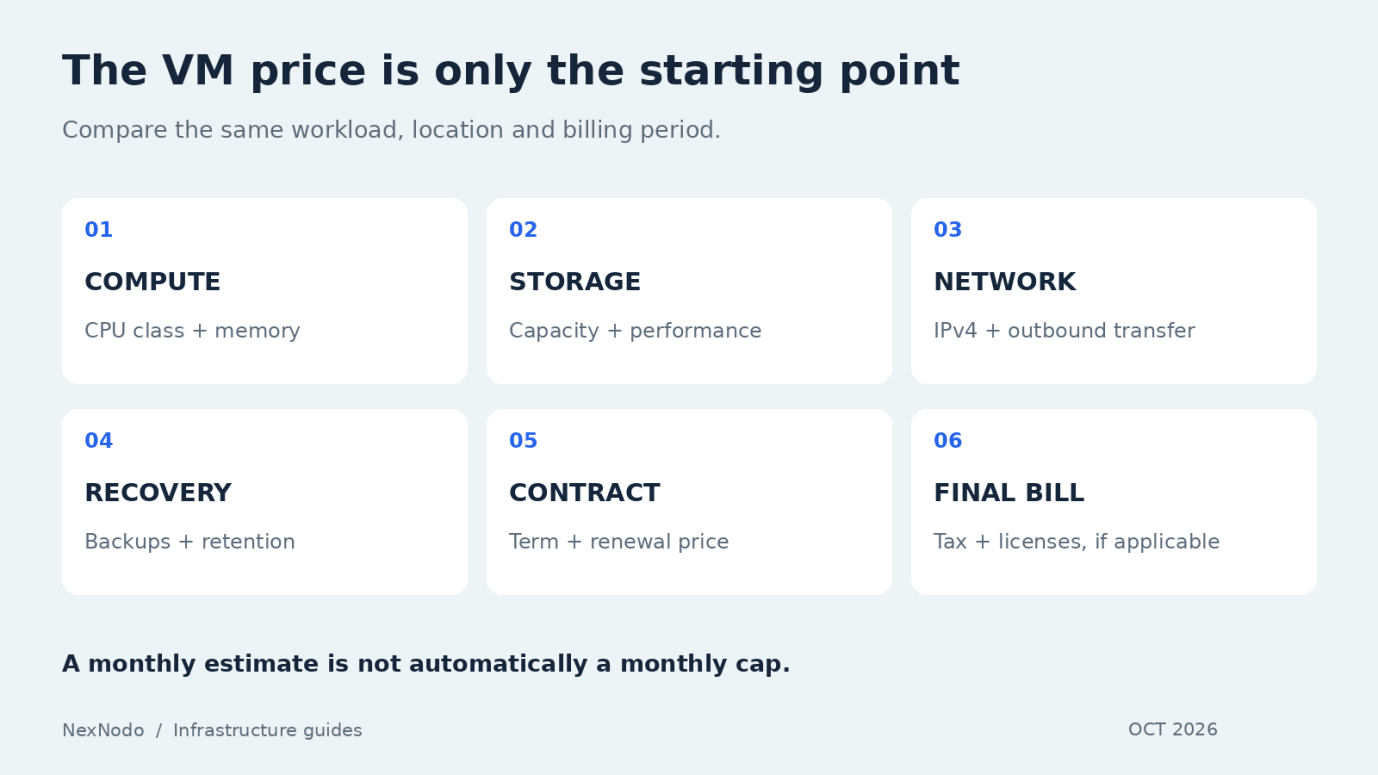
A useful comparison starts with a specification such as: 2 vCPU, 4 GB RAM, at least 80 GB disk, one public IPv4 address and a named European location. Then keep the CPU class and expected transfer volume consistent.
| Cost component | Question to answer |
|---|---|
| Compute | Shared or dedicated? What billing increment and minimum apply? |
| Storage | Is the required capacity included? Are extra volumes charged separately? |
| Networking | Is IPv4 included? What outbound transfer is included? |
| Protection | What backup retention and DDoS coverage does the offer provide? |
| Contract | Is the displayed price promotional or tied to a commitment? |
| Final bill | Are taxes, currency conversion or license charges additional? |
For example, an illustrative €6 VM plus €1 for IPv4 and €2 for backup totals €9 before tax. An €8 package that includes both could be cheaper for that requirement. These figures explain the calculation; they are not provider quotes.
For hourly offers, distinguish a monthly estimate from a contractual cap. Multiplying a rate by 730 produces a comparison estimate, not necessarily an invoice. Calendar months differ in length, and billing rules differ by product.
Check performance with your application
A useful trial measures response time and errors at expected peak load, alongside CPU, memory, disk latency and network throughput. Repeat the test at different times rather than relying on one short synthetic benchmark.
For a database, storage latency and working-set memory may be decisive. For a build runner, completion time and cost per successful build may matter more. For a website, caching and application design can outweigh a small CPU upgrade.
Location needs testing too. Geographic proximity is a starting point; routing can change real latency. “Europe” also includes non-EU countries, so select the actual country required by your organization rather than treating the two labels as equivalent.
Frequently asked questions
Which European VPS provider is cheapest?
There is no useful universal answer without a configuration and billing period. Compare matching resources, required extras, renewal terms and tax treatment. The smallest advertised plan may not run your application comfortably.
Is dedicated vCPU always better?
It can improve CPU predictability under sustained load. It does not automatically solve memory, disk or network bottlenecks. See our KVM and dedicated-vCPU guide.
Should I switch if I find a lower price?
Include migration effort and operational risk in the calculation. Our guide to Hetzner alternatives explains how to decide whether a change is worthwhile.
Find a VPS that fits your workload
Choose the location, CPU class, memory, storage and billing model first. Then compare the providers that can meet those requirements.
Compare available VPS infrastructure on NexNodo.
Source Notes
The article was fact-checked against current provider material on October 8, 2026:
- Hetzner server FAQ: docs.hetzner.com/cloud/servers/faq
- Hetzner price adjustment: docs.hetzner.com
- OVHcloud VPS (Ireland): ovhcloud.com/en-ie/vps
- Contabo Cloud VPS documentation: docs.contabo.com
- Scaleway instance guide: scaleway.com/en/choose-the-right-instance
- Scaleway instance pricing: scaleway.com/en/docs/instances
- DigitalOcean products: digitalocean.com/products
- DigitalOcean Droplet pricing: docs.digitalocean.com
- Vultr Cloud Compute: docs.vultr.com
- Vultr European footprint: blogs.vultr.com/vultr-UK-location
- NexNodo search: nexnodo.com/search
- NexNodo pricing: nexnodo.com/pricing